The key points
- A remiss (referral) is how public care orders tests; private testing does not use one
- At Enkel you order online and walk in to a sampling site in Stockholm, with no appointment to make
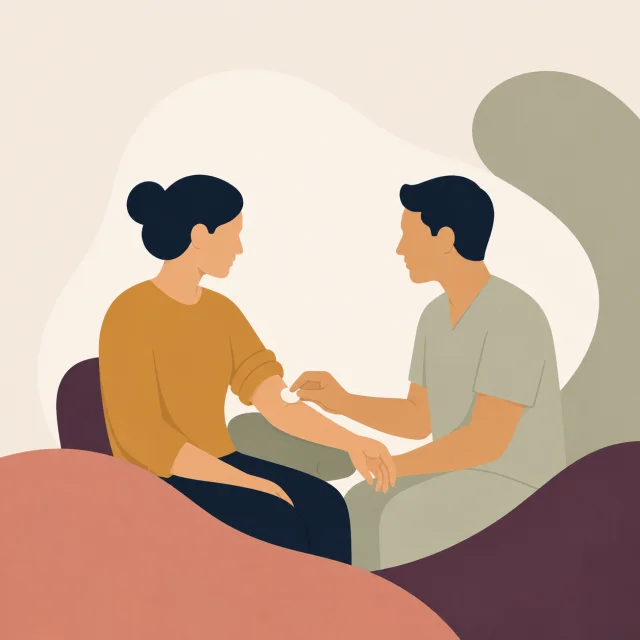
- The sample is venous, taken from the arm by healthcare staff
- Results appear in your account with reference intervals, in Swedish or English
What a remiss is
A remiss (referral) is a notice that you need a more specialised examination or treatment. It is usually written by a doctor. The referral is how public care orders something on your behalf: an examination, a treatment or a test.
For laboratory tests this applies across the country. Every region requires a referral for what is called medicinsk service (medical services), which includes blood sampling. You cannot walk into a hospital laboratory and ask for a test. To visit a vårdcentral (public primary care centre) or an emergency department you need no referral.
Private testing needs no referral
When you pay for the test yourself at a private provider, the order is your own. No doctor needs to write anything first, and you do not need to explain why you want to know.
In practice that is the whole difference. A vårdcentral takes samples when a doctor judges them necessary for a medical question. A private test you take when you want to see your values.
How it works at Enkel
You order your test on the site and pay at once. Then you walk in to a sampling site in Stockholm when it suits you, during opening hours. There is no appointment to make.
The sample itself is taken by healthcare staff and is venous, meaning from a vein in the arm. Once it is done, you are done. The result is placed in your account, where every value is shown with its reference interval.
The draw itself
A venous sample is usually taken from the crook of the arm or the back of the hand. The needle can sting a little, and it passes quickly. Sometimes a small bruise appears and feels tender for a few days. That is normal.
Some analyses require you to fast beforehand. When that applies, it is stated clearly when you order. Most tests require no preparation at all.
Your results
In public care, the result goes to the doctor who ordered the test. When you order yourself, the result is yours. It is placed in your account, which works in both Swedish and English.
Swedish care uses the same units and the same kind of reference intervals that your report shows. If you want to bring a value to your vårdcentral you can, and the doctor there decides what it means for you. A value inside the interval is an answer too.
Common questions
Do I need a referral to order a blood test?
No. The remiss (referral) belongs to how public care orders tests. With a private provider you order yourself, and at Enkel you do it online before walking in to the sampling site.
Do I need an appointment?
No. You walk in when it suits you during the sampling site's opening hours.
Can my vårdcentral use the result?
You can show it to them. The report uses the same units as the rest of Swedish care, and every value comes with its reference interval. What happens next is up to the doctor who sees you.
Is the sample a finger prick?
No. The sample is venous and taken by healthcare staff, usually from the crook of the arm. The sting passes quickly, and a small bruise afterwards is normal.
More articles in the same area
- Understand your Swedish blood test resultsWhat S, P and fP mean on a Swedish lab report, the units g/L, mmol/L and mmol/mol, and how Swedish values relate to American mg/dL and percent.
- Health checks in Sweden for expatsWhat Swedish public care screens for, which invitations arrive at which ages, and where private blood testing fits for you who have moved here.
- Fasting before a blood testWhich blood tests require fasting in Sweden, how many hours it takes, what you may drink during the fast, and what applies to your medicines.
- What does a blood test cost in Sweden, and why do prices vary?The price of a private blood test in Sweden follows the number of markers, the blood draw, the lab analysis and the doctor review. How the parts add up.
This article is general health information, not medical advice and not an assessment of your values. If you have symptoms or concerns, contact your healthcare provider.